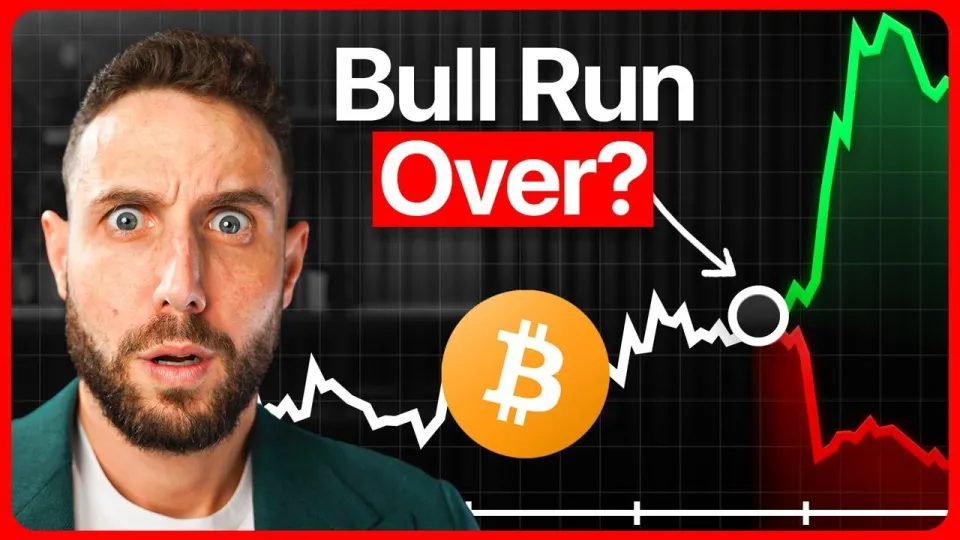
Bitcoin Faces a Two-Day Test That Decides Whether the Crypto Bull Run Survives
You can order the same kind of articles for your own video to boost it on YouTube and Google. Just message the Telegram bot @sat_sit_bot. The bot writes and publishes the articles itself (with your YouTube video embedded) on popular topical websites (no ads). Your first 50 articles are free.
· based on the channel EllioTrades
Key takeaways
- The weekly Bitcoin candle close is framed as the deciding event, with roughly two days left before it prints.
- The bull case stays valid only if BTC holds its weekly support zone; a decisive break shifts the plan to lower buy levels.
- A reclaim that pushes BTC back toward 100K is the scenario that would re-confirm the uptrend.
- Altcoins are treated as a second-step trade: only buy after BTC support holds, not before.
- A short, shallow bear market would likely produce a weaker next bull cycle than a deeper reset.
Bitcoin has roughly two days before its weekly candle closes, and that close is the single event most likely to decide whether the crypto bull run continues or breaks down. The working plan is simple: BTC must hold its weekly support zone into the close, and a failed hold turns the setup into a wait-for-lower-levels scenario rather than a buy. Traders who want to position around the outcome can use Kalshi's event markets via the EllioTrades link to express a view without holding spot.
Why the weekly close matters more than any single daily candle
A weekly close is the market's summary of five days of positioning, and it is the level that larger funds, trend models and on-chain valuation bands actually reference. Daily candles inside the week are noise; the weekly print is the verdict.
The logic behind the two-day deadline is mechanical rather than mystical. Bitcoin has been trading near a support band that has repeatedly absorbed selling. If buyers defend it into the weekly close, the structure of higher lows stays intact and the bull run keeps its footing. If sellers force a close below it, the same band flips into resistance, stops get triggered underneath, and the next demand zone sits materially lower.
That is why the framing is binary. A hold keeps the uptrend narrative alive and keeps altcoin rotation on the table. A break does not automatically mean a bear market, but it does mean the easy long entries are gone and the plan shifts to accumulating at lower prices.
The levels that define the bull case and the invalidation
There are three reference points worth tracking into the close, and each one changes the plan.
- Weekly support. This is the line in the sand. A close above it keeps the higher-low structure valid and allows longs to stay on.
- The reclaim zone toward 100K. If BTC holds support and pushes back up, a move toward the 100,000 level is the confirmation trade. Reclaiming that area would signal that the pullback was a shakeout, not a trend change.
- The lower demand band. If the weekly close fails, the plan is not to panic-sell but to wait for BTC to trade into the next support cluster and buy there with a wider time horizon.
The important nuance is that a break does not invalidate the whole cycle in one candle. It invalidates the current setup. Those are different things, and conflating them is how traders end up selling the bottom of a pullback or buying a falling knife.
What a hold would mean for altcoins
Altcoins are a second-step trade, not a first-step trade. The sequence that matters is BTC holds weekly support, BTC stabilizes, then capital rotates down the risk curve into large caps and eventually into smaller names.
If support holds, the coins worth watching are the ones that have already shown relative strength during the pullback, meaning they lost less than BTC or reclaimed their own levels faster. Those are the names that tend to lead when rotation begins. Buying altcoins while BTC is still testing support is the mistake that turns a good thesis into a bad entry.
If support breaks, altcoins typically fall harder than Bitcoin in percentage terms, because liquidity thins out and beta works in both directions. In that scenario the correct move is patience, not averaging down into every dip.
The bearish case: what a failed close would actually trigger
A failed weekly close would trigger three things in sequence. First, stop losses clustered under the support band would execute, adding sell pressure. Second, trend-following models that use weekly closes would flip or reduce exposure. Third, sentiment would sour quickly, which is exactly what happens when a market goes from broadly bullish to cautious on a single retracement.
The counterargument from the bearish side is worth taking seriously: if the market makers step away over a weekend and retail flow is thin, a weekly close can be pushed around by low liquidity. That is a real risk, and it is why the close matters more than the intraday wick. A wick below support that recovers by the close is very different from a close below support.
There is also the macro overlay. Equity indices have not yet gone through a meaningful correction, and if one arrives, crypto will not decouple on the downside. A multi-year bear scenario built on a sweep of the 97K area and a long range between roughly 50K and 100K is a legitimate alternative map, even if it is not the base case.
The bull-market length debate and other common doubts
The most substantive pushback on the bullish side is not about levels, it is about cycle length. A very short, shallow bear market tends to produce a weaker next bull run, because the market never fully resets positioning, leverage and valuation. A deeper flush clears the deck and gives the following expansion more room.
That creates a genuine tension for anyone hoping to buy cheaper. Wanting a major setback to get better entries means accepting a lower probability that the bull market continues at all. A market that forces you to dollar-cost average higher is, counterintuitively, the healthier one, because it confirms demand rather than questioning it.
The second common doubt is about sentiment whiplash. One retracement is enough to flip a large share of the market from very bullish to bearish, which is a behavioral signal more than a technical one. The third is event risk outside price: index-provider decisions on digital-asset treasury companies, for example, can move related equities and, through them, sentiment toward crypto more broadly.
How to build a plan around the two-day window
A workable plan for the next two days has four parts.
- Decide in advance what a hold looks like and what a break looks like, using the weekly close, not an intraday print.
- Size positions so that a break below support does not force an emotional exit at the worst price.
- Keep a shopping list of altcoins with relative strength ready, but do not execute until BTC confirms.
- Predefine the lower levels where you would add if the close fails, so the decision is made before the stress arrives.
Discipline here is less about prediction and more about response. The market will tell you which scenario is playing out by where the weekly candle settles.
Tools and links from the breakdown
- Kalshi event markets with the EllioTrades bonus link
- Liquid trading with 10% off fees
- WEEX deposit promo: deposit $100, unlock up to $4,000 in bonuses
- EllioTrades' public trading journey on fomo
- EllioTrades on X
The bottom line on Bitcoin's two-day test
The next weekly close is the decision point: hold support and the bull run stays intact with a path back toward 100K, break it and the plan becomes accumulation at lower levels rather than chasing. Altcoins only enter the picture after Bitcoin confirms. The full breakdown, including the level-by-level trading plan, comes from the EllioTrades channel. If you want to trade the outcome directly, open a Kalshi account through the EllioTrades link and position around the scenario you expect.
Questions & answers
What happens if Bitcoin closes the week below support?
The setup invalidates rather than the entire cycle. Stops under the support band would trigger, weekly-close trend models would cut exposure, and the plan shifts to buying at lower demand zones. Altcoins would likely fall harder in percentage terms, so patience beats averaging down immediately.
Why is a weekly close more important than a daily candle?
A weekly close summarizes five days of positioning and is the reference used by larger funds and trend models. An intraday wick below support that recovers by the close is a very different signal from a close below support, which is why the close is the trigger.
Is it better to hope for a deeper crash to buy cheaper?
There is a trade-off. A deep flush gives better entries but lowers the probability that the bull market continues. Being forced to dollar-cost average higher actually confirms demand and raises the odds of larger gains, so wishing for a major setback is not a free lunch.
Which altcoins should be bought if Bitcoin holds?
Focus on names that showed relative strength during the pullback, losing less than BTC or reclaiming their own levels faster. Execute only after BTC confirms the weekly hold, since altcoins carry higher beta and fall harder if support breaks.
Source: Bitcoin Has 2 DAYS to Save the Crypto Bull Run · Markdown version